
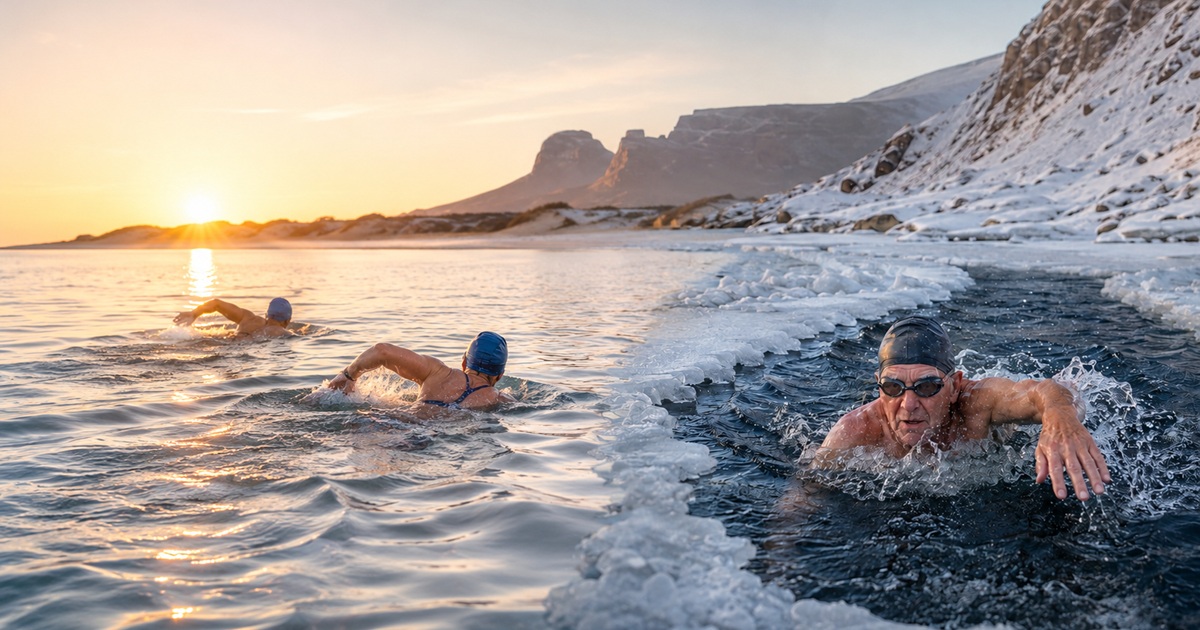
Derrick Levy, Jane Hudson and Elred Lawrence are cold-water swimmers – all in their 70s. However, their experiences in cold water are remarkably different. One competes in extreme ice-swimming events, while the others swim for pleasure, routine and the sheer joy of feeling alive.
The Cold Is Calling
For some, the thought of entering icy water is enough to send a shiver down the spine. For others, it is the best possible way to begin the day.
Cold water swimming has attracted people of all ages, including a growing number in their 60s, 70s and beyond. Some are drawn to the physical challenge, while others value the friendships, connection with nature and lift in mood.
Derrick, Jane and Elred are three swimmers in their 70s with very different approaches to the cold. Their stories show that there is no single reason to take the plunge and no single way to enjoy it.
Derrick Levy: 79 Years Old, 100 Metres and Water at 2°C
At 79, Derrick Levy did what few people of any age would dare attempt. Competing at the IISA South Africa Ice Swimming Championships in Lesotho in August 2026, he completed both the 50-metre and 100-metre events in water measuring a punishing 2°C.
Derrick finished 12th overall in the 100 metres and took first place in the 75 to 79 age group. He was also the oldest swimmer at the championships.
The freezing water was only part of the challenge. The event took place more than 3,000 metres above sea level, where the thin air made breathing considerably harder. Derrick also had four heart stents and a torn rotator cuff, so medical clearance and careful preparation were essential.
For three months, he trained with supervised cold open-water swims, pool sessions, gym work, physiotherapy and ice baths. His wife, Suzanne, acted as his event seconder, while his doctor, trainer, physiotherapist and biokineticists helped prepare him.
“To swim in Lesotho at 2°C, I knew I had to endure the ice-water pain threshold,” Derrick said. “This would be a mind-game swim.”
During the 100 metres, he fought the pain of the cold, the high altitude and desperate gasps for air. He kept moving until he reached the finish buoy.
It was a performance built on preparation, strength, determination and extraordinary grit. Ice swimming is cold water swimming taken to the highest level, with virtually no margin for error. Derrick did not simply endure it. He finished strongly.
Jane Hudson: The First-Light Swimmer
For Jane Hudson, cold water swimming is not about competition or breaking records. She describes herself as a casual swimmer who takes the plunge simply because it makes her body and mind feel good.
The first contact with the water is always a jolt, but that quickly gives way to exhilaration. Jane says the experience leaves her feeling uplifted and physically stronger.
A creature of habit, she swims at first light and follows a familiar routine, completing a set number of lengths depending on whether she is swimming in a marina or an outdoor pool. In the pool, she also includes exercises that are not possible in the sea.
Swimming provides more than a physical boost. Jane is an author, and some of her best writing ideas arrive while she is doing laps. When she is stuck on a scene or unsure how to move the plot forward, the rhythm of swimming often creates the space for an “aha” moment.
Jane admits that, as a beginner, she occasionally stayed in the water slightly too long. Experience has taught her to respect her limits and follow the routine that works for her.
Her recovery usually involves a hot shower or, occasionally, a bath. Although getting up at first light can be particularly difficult during winter, the physical and emotional boost keeps her returning.
Her most important advice for anyone trying cold water swimming for the first time is simple: always swim with a buddy.
Never underestimate a swimmer in her 70s
Jane may describe herself as a casual cold water swimmer, but her swimming résumé tells a far more adventurous story.
During an expedition to Antarctica aboard a small, 34-passenger Russian ice-class vessel, she completed her first sub-zero swim in seawater measuring minus 1.5°C. She later took an Arctic polar plunge at a latitude of 82 degrees North. Many years later, during a trip to South Georgia, she braved the freezing water for a third polar plunge.
Three polar plunges, some of the most remote waters on Earth and a regular first-light swimming routine back home. That is far from ordinary.
Jane’s adventures are a joyful reminder that people in their 70s are not stepping away from life. Many are still travelling, creating, testing themselves and collecting stories in places most people will never reach.
So, never underestimate a 70-something year old. The person quietly swimming lengths beside you may also be an author, an adventurer and a veteran of three polar plunges.
Elred Lawrence: Sunrises, Friendship and Feeling Alive
Elred swims in the sea at Surfers Corner in Muizenberg, or as he puts it “he gambols in the waves and body-surfs”. What began as summer swimming gradually continued into winter, when he discovered that cold water swimming could be genuinely pleasurable.
In fact, he now prefers cold water to warm water. Swimming in water around 28°C during a visit to Thailand held far less appeal for him.
The first minute at Muizenberg depends largely on the tide. At low tide, the long walk through shallow water can feel like “forever torture”. Once the water reaches his stomach and he becomes submerged, everything changes.
At high tide, the waves arrive immediately. The shock is sudden, but he describes the feeling that follows as magnificent.
For Elred, the experience is about far more than water temperature. He loves visiting the beach in the morning, watching the sunrise, spending time outdoors and enjoying the camaraderie of his fellow swimmers.
Most importantly, it gives him a profound sense of being alive, something for which he says he is “very, very grateful”.
Cold water swimming consistently lifts his mood. He returns home happy and ready for a hot shower and a cup of coffee.
His advice to beginners is to start gently during summer and allow the falling temperatures to arrive gradually.
“If you decide to go on the coldest, rainiest, wintriest day when the water temperature is 10°C, you’re probably not going to like it and you’re probably not going to do it again,” he says. “Start when everything is nice, and then it doesn’t take long for it to become a habit.”
Elred initially used a visible clock to limit his swims to 20 minutes. Today, he listens to his body and usually gets out after approximately 15 to 20 minutes.
His experience should not be treated as a universal safe duration. Water temperature, health, conditions and individual cold tolerance differ. The safest approach is to leave the water before movement, breathing or judgement begins to deteriorate.
Three Swimmers, Three Reasons to Return
Derrick, Jane and Elred enter cold or ice water for different reasons.
Derrick is drawn to an extreme sporting challenge that demands intensive training and medical supervision. Jane values routine, exhilaration and the feeling of becoming stronger. Elred returns for the sunrises, friendships, natural surroundings and gratitude of feeling fully alive.
Their experiences also share important common ground. Each swimmer understands the value of preparation, routine and knowing when to get out.
Their stories are proof that life in your 70s does not need to become smaller, quieter or less adventurous. But they are not an invitation to ignore the risks.
Cold water should never be about bravado. Start gradually, consider your health, swim with others and respect your personal limits.
Age may shape the preparation, but it does not have to extinguish the spirit of adventure.
A YEI article
Read all about ‘Cold water swimming after 60: The benefits, the risks and how to take the plunge safely’ – click here