
Five South African women, Monique, Moira, Benita, Sue and Susan walked 280km across Portugal and Spain. A journey of friendship, resilience, and powerful life lessons. They found something unexpected at the end of the Camino. This is the part no one tells you about.
How it started… The Fab Five Camino: Five SA Women Walk 280km – click here to read Part One
It began in the rain. Not the gentle kind that makes everything feel poetic, but the sort that settles in and stays, soaking through shoes, tugging at jackets, and turning those first kilometres into something far more real than any of them had imagined when they first spoke about walking the Camino back home in Cape Town. There were broken boardwalks along the coast, wind coming in hard from the Atlantic, and that quiet, unspoken question that sits somewhere in the back of your mind when things feel harder than expected. What on earth have you signed up for?
They laughed, of course. Called themselves “drain rats” and kept moving, because that is what you do. You take the next step, and then the next, and somewhere along the way the doubt softens and the rhythm begins to take over.
Finding the rhythm
At the start, there is a lot to think about. Distances feel long, decisions feel important, and every stop matters. But the Camino has a way of changing that. Gradually, almost without noticing when it happens, the thinking gives way to something simpler. You wake, you pack, you walk.
Some days they moved together, talking easily, sharing stories that stretched back years. Other days they drifted apart, each woman settling into her own pace, her own thoughts, with the quiet understanding that they would find each other again. And they always did.
Part of that rhythm came from the people who appeared along the way, sometimes briefly, sometimes repeatedly, until they became familiar. A pilgrim from the Czech Republic before they had even begun. A Norwegian man at a tap who received a very South African reminder about wasting water. A Mexican pilgrim and his American friend who seemed to reappear just when you least expected it. Lukasz from Poland. Greta. Otto. Dutch Kim. German girls. Italians.
You begin by noticing people. By the end, you recognise them, sometimes without even exchanging words, just a nod or a smile that says, we’re still going.
The harder days
It would be easy to tell this as a simple story of adventure, but the truth is that the Camino is not easy. There are long stretches where the road climbs when you wish it wouldn’t, days where the rain settles in and refuses to lift, and moments when there is nowhere to stop, nowhere to sit, and you simply keep going because there is no other option.
There were times when they found themselves sitting in the rain after being turned away from a café, not quite sure whether to laugh or feel annoyed, and days when the cold lingered longer than expected.
And yet, those moments do not define what stays with them.
What stays are the small things. A café owner offering boiling water so they could make rooibos tea when they were cold through to the bone. A place to sit – appearing just when it felt like they could not take another step without stopping. Someone offering help without being asked.
When the Camino provides
It is around this point that something people often say begins to make sense. “The Camino will provide.”
Monique thought of it as one of those phrases people repeat because it sounds good. And then, slowly, she began to notice it happening.
They would be walking, tired, carrying their packed lunch, quietly hoping for somewhere to sit, and someone would say it, half jokingly, almost like a request. Please, can the Camino provide a table and chairs! Maybe even next to a little stream.
And then, a little further along the road, there it would be. A table. A bench. Sometimes, incredibly, even the sound of water nearby. Not every time, but often enough that it stopped feeling like coincidence.
At other times, it felt far more personal. Monique’s foot had been troubling her, not enough to stop her but enough to become a concern. She needed something very specific, a silicone metatarsal pad, the sort of thing you do not expect to find easily in a small town along a walking route. That evening, as they arrived, she walked into the first pharmacy she saw. They had exactly what she needed. It carried her all the way to the end, right through to Finisterre, to the moment she stood at the lighthouse. The next morning, when she reached for it again, it had torn apart.
It had lasted exactly as long as it needed to.
The final stretch
By the time the last day arrived, their bodies had changed in ways that are difficult to explain to someone who has not walked that distance. What had once felt daunting now felt manageable, even familiar, and yet the morning itself did not feel like a celebration. It felt quieter than that. Almost tentative. “Everything we had worked towards was this day.”
As they walked, the feeling began to shift. The rhythm returned, the kilometres passed more easily, and there was laughter again. They knew how to do this now. They knew how to pace themselves, when to stop, when to keep going.
And yet, as they drew closer, other feelings emerged. Not quite relief. Something closer to hesitation. Emotion. Tears. Because finishing something like this means letting it go.
Arriving
There is no dramatic build-up.
You turn a corner, and the Cathedral opens up in front of you. The square is full, filled with people arriving in their own way, some emotional, some celebratory, some simply standing still and taking it all in.
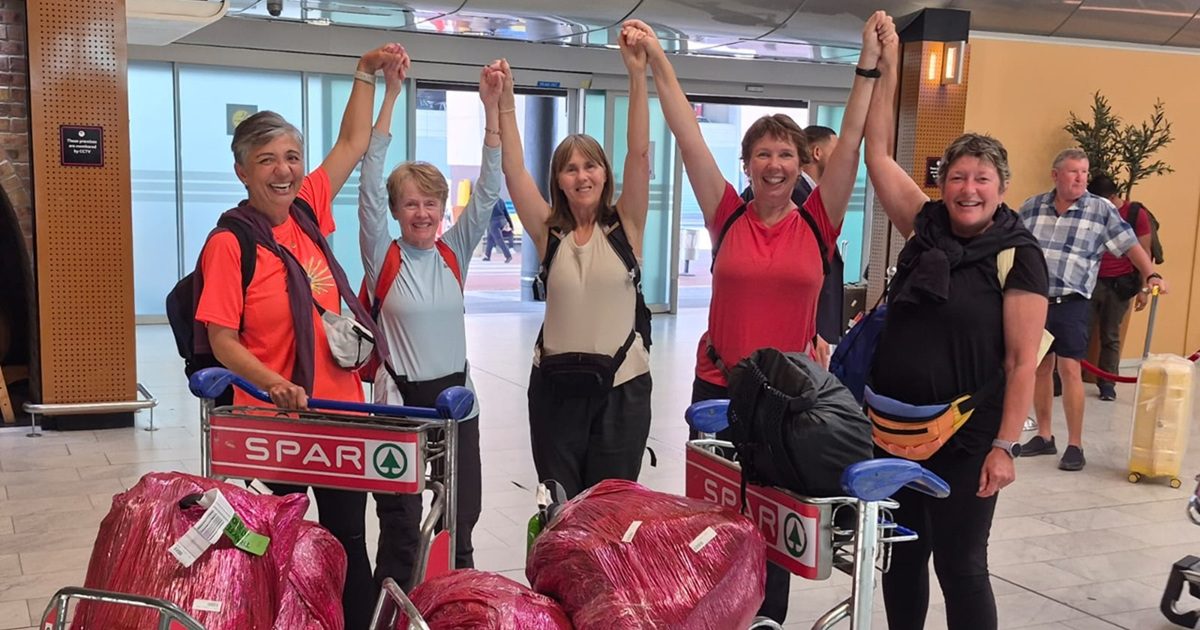
The Fab Five walked in together.
There was no big reaction. No tears. No shouting. Just a pause. A look. A quiet understanding.
Monique had expected something different. She thought she would be overwhelmed, but she wasn’t.
None of them were. Instead, there was a sense of completion. Something settled rather than released.
What stayed
If you ask what the Camino gave them, the answers are not dramatic. They are simple.
Benita had said at the start “I’m walking the Camino, because I can. Over time, that changed. It came to mean something deeper, an awareness of privilege, of being healthy enough, strong enough, able to do something like this. There were moments of anxiety along the way, but she found her way through them by trusting that what she needed would be there. And it was.
Another realisation came more slowly. That self-sufficiency is a myth. That even when you walk apart, you are held in something larger, in the quiet awareness of others who are walking with you. And then, perhaps unexpectedly, the journey brought her back to something familiar. Walking through Portugal and Spain, meeting people, observing the way things worked, she found herself thinking about home, about what they have, about the richness of it. “In Africa, we are rich,” she said. Benita’s overall feeling was one of joy – the joy of walking in nature, the joy of the simple things in life. Her faith has become stronger. “I have finished this journey with a sense of contentment and know now that life is good.”
A journey that waited
For Monique, this journey had been years in the making. She had wanted to do it since her early 40s, but life has its own timing. Work, responsibilities, everything that fills the years in between. “For years I thought I had missed my chance”. And then, at 61, she was ready. Fit enough. Strong enough. Able to go.
Looking back, she does not see it as something delayed, but something that arrived when it was meant to. “I didn’t miss my time,” she said. “I arrived at it.” “The Camino was waiting – waiting for the time when my body, my life, and my spirit could finally walk as one.”
Finisterre
For many pilgrims, the journey does not end in Santiago. It continues to Finisterre, where the land gives way to the ocean and there is nothing beyond it.
Each of them had carried a small stone from home, something that held meaning, something they were ready to let go of. Standing there, with the wind and the sea and the long journey behind them, they took a moment.
And then, one by one, they let those stones go. There was no ceremony. There did not need to be.
And afterwards
They returned home with less than they started with, at least in the physical sense, and more in ways that are harder to describe.
A clearer sense of what matters. A deeper appreciation for connection. A quiet understanding that the simple things are often the ones that stay.
They walked the distance. They finished what they set out to do.
And yet, the way they tell it, it was never really about the finish. It was about choosing to begin.
Buen Camino.
A YEI article