

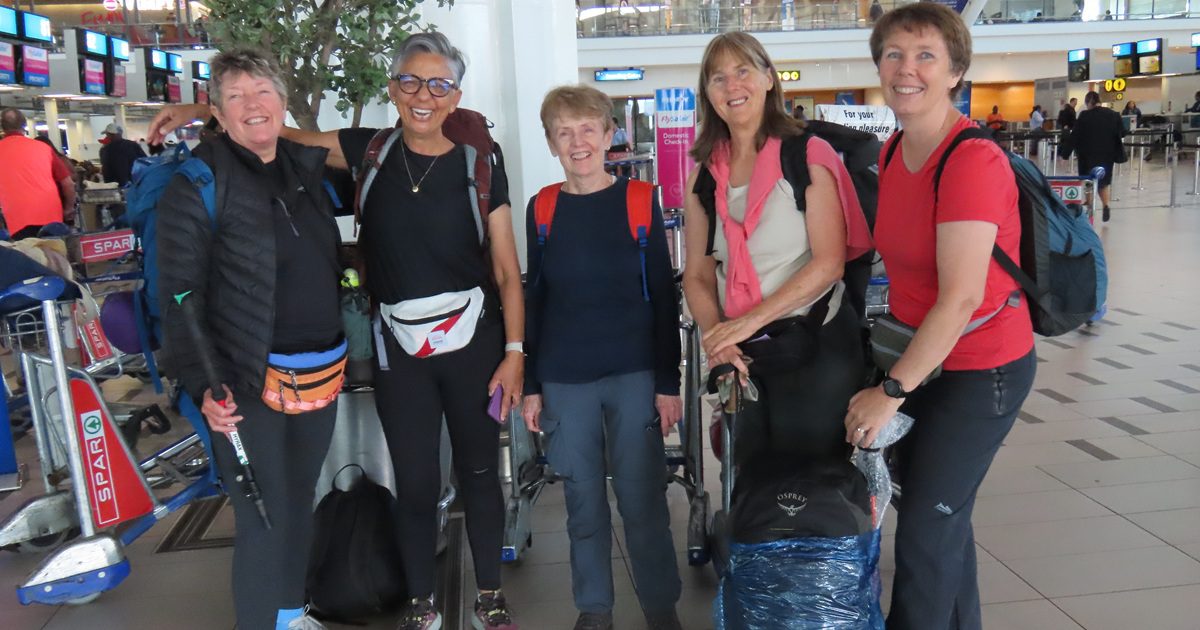
“The Fab Five” are five South African women in their late 50s, 60s and 70s who are taking on the Camino. The Camino de Santiago is a long-distance walk (280km) from Porto in Portugal to Santiago in Spain. The Fab Five are doing this walk together as a deliberate choice – to live fully, to move forward together, and to say yes while they still can.
The Camino de Santiago, also known as “The Way of St James,” is a network of ancient pilgrimage routes – about 18 in total – all leading to Santiago de Compostela in northern Spain. For centuries, pilgrims have walked these routes for spiritual, physical, and personal reasons. Today, the Camino continues to draw people from all over the world, and in recent years it has seen record numbers of participants.
Meet Monique, Moira, Sue, Susan and Benita – the Fab Five. They met through a Cape Town hiking community. Over time, shared trails became shared trust, and casual conversations turned into something more ambitious. Monique had quietly carried the idea of walking the Camino for years. When she finally booked her trip – prepared to go solo – her four friends decided to join her.
Choosing “Now”
What pushed them from “one day” to “now” was not a sudden burst of bravado, but something more grounded: life experience.
Three of the ladies in the group have faced major health challenges. Among them are survivors of breast cancer (in one case, twice), melanoma, and a brain tumour. Those experiences brought a shared understanding of how quickly life can change – and how precious physical ability really is.
They are not naïve about the demands of the Camino. Most days will involve walking 20 kilometres or more, with some stages exceeding 30 kilometres. But they are clear-eyed and realistic. They have trained together. They know how to pace themselves. And, perhaps most importantly, they know what it means to endure.
“We survived,” one woman reflected during their planning. “And we can still do this physically. Life is for living.”
Walking Together – and Apart
Although they are walking as a group, they have deliberately built flexibility into the journey. Each woman is free to walk alone during the day if she wishes – leaving earlier or later, setting her own pace. The only firm agreement is that they will sleep in the same place each night, ensuring safety, support, and shared connection at the end of each day.
They have chosen to carry their own backpacks. For them, this matters. The Camino is a pilgrimage, not just a hike, and carrying one’s own belongings feels integral to the experience. It is part of the authentic pilgrim experience. And let me add, I saw and held one of the already-packed backpacks – 7kg. It was mega heavy!
Near the end of the journey, the group has planned a well-deserved pause: a house with hot showers, laundry facilities and massages – proof that pilgrimage and practicality can happily coexist.
Ritual, Meaning, and the End of the World
For many pilgrims, the Camino’s meaning unfolds slowly, step by step. The group is particularly drawn to what comes after Santiago: Finisterre (or Fisterra), a rugged point on the Atlantic coast once believed to be the end of the known world.
Here, pilgrims traditionally stop to reflect. Some sit quietly and contemplate the journey. Others take part in symbolic rituals. One such tradition involves carrying a small stone from home -representing burdens, worries, or unresolved chapters -and casting it into the sea at Finisterre, letting go of what no longer serves them.
It is not about drama or grand gestures. It is about release.
Becoming a Pilgrim
To be recognised as official pilgrims, the ladies registered with the Confraternity of St James (South Africa), based in Milnerton. Through this process, they received pilgrim credentials – an essential document on the Camino – and supporting letters required for their Schengen visas.
Along the route, they will collect stamps in a pilgrim passport, gathering at least two stamps per day from albergues, cafés, churches, and restaurants. These stamps serve as proof of the journey. At the end, having walked more than the required minimum of 100 kilometres, they will be eligible to receive the Compostela certificate – a beautifully crafted document confirming completion of the Camino.
Pilgrim life also comes with small, practical kindnesses. Many restaurants along the route offer pilgrim meals -simple, nutritious, and affordable – designed for those walking long distances day after day.
There are many ways to complete the Camino: walking, cycling, even horseback riding. Each has its own rules and distances. This group has chosen the simplest and oldest way – on foot.
A Message for Other Women
When asked what they would say to other women watching from afar, their message is consistent and uncomplicated:
Do it while your body can. There is no time like the present.
Their Camino is not about proving anything to anyone else. It is about honouring resilience, friendship, and the quiet courage it takes to choose yourself – even later in life.
You’ve Earned It will follow their journey and share reflections when they return, having walked their own version of the way.
Buen Camino to the Fab Five – Monique, Moira, Sue, Susan and Benita
An article by YEI

Wonderful story about the ladies who decided to take on the Porto to Santiago Camino. I leave for a 6 day walk on 23rd May Tui To Santiago .
Beun Camino!
Keep your eyes peeled for the follow-up to this article. The Fab Five have completed the Camino and will be sharing insights on the journey as a whole. Good luck with your Camino – we admire all those who take on this tough challenge! Let us know how you get on, and do share your story of this. We would love to read and publish this.
The YEI Team
Where can we find booking information
Hi Trudi – can you clarify what you are looking for? Information to book the Camino?
The YEI Team
🙌Well done ladies
Such an amazing experience. Congratulations.
My husband and I walked from Sarria to Santiago in our sixties. It was one of the best holidays we had ever experienced.
I walked from Leon in Spain to Santiago, then Finistere for my 60th bday. I flew to Madrid and by train to Leon to begin there. I walked with 2 friends; one of whom rather walked from Sarria. We walked average 9km each day and enjoyed whatever there was to see in each stay-over village in the afternoon. What a fantastic experience to sit on a rock watching the sun set over the Ocean at the “edge of the medieval “known world” ” on my 60th b’day.
I encourage more people to do it.