
Which health checks should be on your radar after 55?
This practical guide brings together screening guidance, menopause research and medical aid benefits to help you take charge of your health.
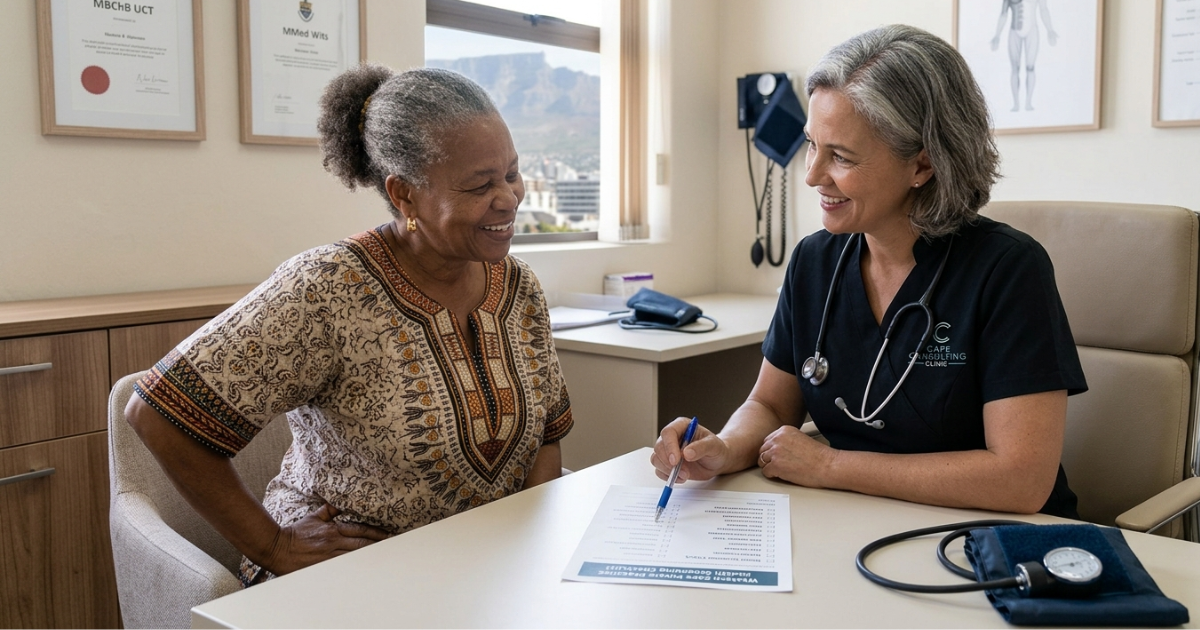
One in 27 South African women will get breast cancer at some point in her life, according to the National Cancer Registry. And most research into menopause has been done on women in Europe and America, not here. This checklist brings together South African screening guidelines, a South African study on menopause, and a comparison of what our biggest medical aids actually pay for, so you know exactly what to ask your doctor for next.
Why screening after 55 matters
Many of the health risks women face become more common after menopause. Once your body’s oestrogen levels drop, your heart loses some of its natural protection, your bones lose density faster, and your risk of diabetes goes up. A 2022 South African study, Menopause is associated with bone loss, particularly at the distal radius, in black South African women, followed a group of South African women through menopause and found their bones, especially at the wrist, lost density during this time. It comes from the Study of Women Entering and in Endocrine Transition, known as SWEET, South Africa’s first major study built specifically around Black South African women going through menopause. It confirms that what we know about menopause worldwide holds true here too, and it means South African women deserve health guidance built on evidence about their own bodies, not just imported from elsewhere.
The core screening checklist
Cancer screenings
| Screening | South African guidance | Why it matters |
| Mammogram | CANSA recommends a mammogram every year from 40 to 54, then every two years from 55, or every year if you prefer. The Radiological Society of South Africa recommends yearly screening from 40 to 70. | Breast cancer is the most common cancer among South African women. |
| Pap smear / cervical screening | The National Department of Health offers three free Pap smears in a lifetime through public clinics, starting at age 30, ten years apart. CANSA recommends a yearly Pap smear for sexually active women. Women living with HIV should keep screening at any age. | Cervical cancer is a major cause of cancer death for South African women, and many cases are found late in women who stopped testing too soon. |
| Colon screening | Not yet a standard public sector programme, but from age 45 it is worth asking your doctor about a colonoscopy every 10 years or a yearly stool test. | Caught early, colon cancer is highly treatable, and screening can even stop it before it starts by removing small growths. |
| Lung screening (if you smoke or used to) | If you have a long smoking history, ask your doctor about a low dose CT scan from age 55. | This kind of scan can catch lung cancer earlier, when it is easier to treat. |
Heart and bone health
| Screening | Guidance | Why it matters |
| Bone density scan (DEXA) | Recommended after menopause, and earlier if you have already had a fracture or other risk factors. | The SWEET study found South African women lose bone density, especially at the wrist, during menopause. Bone loss usually has no symptoms until a bone breaks. |
| Blood pressure and cholesterol | Get these checked regularly from midlife onward. | Your heart loses some natural protection once oestrogen levels drop after menopause. |
| Diabetes screening | Every three years from age 45, more often if you have other risk factors. | Your risk of diabetes rises during and after menopause. |
Everyday checks that get overlooked
| Screening | Guidance | Why it matters |
| Eyes | Every two to three years from 55 to 64, every year if you have diabetes or existing eye problems. | Conditions like glaucoma become more common as you age. |
| Hearing | Worth mentioning at your next check-up. | Treating hearing loss is one of the things you can actually do something about to help protect your memory and thinking as you age. |
| Vaccines | A flu shot every year, a shingles vaccine from age 50, and a tetanus and diphtheria booster every ten years. | Your immune system naturally weakens with age, so these matter more, not less. |
What your medical aid covers
Discovery, Bonitas, and Momentum are South Africa’s three biggest open medical schemes, meaning anyone can join them. Together they cover most South Africans who belong to a medical aid. Here is what each one pays for, with a direct link to their benefit page so you can check the details for your own plan.
| Screening | Discovery Vitality | Momentum | Bonitas |
| Mammogram | Earns 2 500 Vitality points a year from age 40 | Covered under the Health Platform Benefit | One every 2 years from age 40, on most plans |
| Pap smear / HPV test | Earns 2 500 points a year, ages 25 to 65 | Covered under the Health Platform Benefit | One Pap smear every 3 years, or one HPV test every 5 years, ages 21 to 65 |
| Colon screening | Earns 2 500 points a year from age 45 | A stool test is covered under the Health Platform Benefit | One stool test, ages 45 to 75, on most plans |
| Bone density scan | Earns 2 500 points a year for women 65 and older | Covered under the Health Platform Benefit | Not usually a standard benefit, check your plan |
| Cholesterol, blood sugar, blood pressure, weight | Part of the Vitality Health Check, worth up to 22 500 points | Part of a digital health check called the Healthy Heart Score | Free annual wellness check on all plans |
A quick note on how these work.
Discovery Vitality gives you points for each screening, so it lines up closely with the checklist above. Momentum has moved toward a quick digital health check using your phone, called the Healthy Heart Score, while the actual clinical screenings sit under a separate benefit. Bonitas simply pays for the screenings directly as part of your plan, though exactly what is covered depends on which plan you have. Always double check with your own scheme before booking, since benefits can change from year to year.
Questions South African women ask about health screening after 55
What screenings should I have every year after 55?
A yearly flu shot, a blood pressure and cholesterol check, and a Pap smear if you have not switched to five yearly HPV testing. A mammogram every one to two years and a bone density scan after menopause round out the basics.
Do I still need a Pap smear after menopause?
Yes. South African guidance says to keep going until age 65, and women living with HIV should never stop. Many cervical cancer cases are found late simply because women stopped testing too soon.
At what age should I get a bone density scan?
Most guidance says after menopause, rather than a fixed age, and earlier if you have already broken a bone or have other risk factors. A South African study, the SWEET study, found women’s bones lose density during menopause, especially at the wrist. Discovery Vitality rewards this test from age 65, but your doctor may suggest testing sooner based on your own health.
Does my medical aid pay for a mammogram?
Most major South African medical aids cover mammograms from age 40, though how often differs. Discovery Vitality rewards one every year from 40, while Bonitas usually pays for one every two years from the same age. Check your own plan to be sure.
Is hearing loss really linked to memory problems?
Yes. Treating hearing loss is considered one of the more useful things you can do to help protect your brain health as you age, alongside looking after your heart and bones.
What is the difference between a Pap smear and an HPV test?
Both check for cervical cancer risk. A Pap smear looks directly at your cervical cells for anything abnormal. An HPV test checks for the virus that causes most cervical cancers. Several South African medical aids now let you choose an HPV test every five years instead of a Pap smear every three.
What health experts say beyond the standard checklist
Screening guidelines tell you what to test for. A few well known voices in women’s health add a useful layer on top, around what to actually do with the results.
Dr Stacy Sims, an exercise and nutrition scientist, is known for pushing three things for women in midlife: a bone density scan, a fitness test called VO2 max that measures how well your heart and lungs use oxygen, and regular strength training. Her view is that muscle and bone are not just about looking fit, they are core to staying independent and healthy as you age. If your bone density scan comes back fine, she would still argue it is worth asking your doctor or biokineticist about a fitness assessment and a strength training plan.
Locally, Dr Nicole Jaff, the researcher behind the SWEET study mentioned above, is one of the few South African voices building menopause guidance from South African data rather than importing it. She also sits on the Executive Council of the South African Menopause Society, a good place to start if you are looking for a menopause specialist near you. Dr Malikah van der Schyff, a gynaecologist with 20 years at MediClinic Constantiaberg, has spoken publicly about the gap between what women get in public versus private healthcare in South Africa, worth keeping in mind if your own access to screening looks different from what this checklist describes.
Internationally, Dr Mary Claire Haver and Dr Sara Gottfried, both medical doctors who focus on menopause, are useful further reading if you want to go deeper on any one topic here, particularly hormone health and how it connects to the heart and bone changes covered above.
None of this replaces your own doctor. Think of it as a starting point for a better conversation at your next appointment.
Organisations worth knowing about
If you want to go straight to the source rather than take our word for it, these are the organisations behind the guidance in this checklist.
– Cancer Association of South Africa (CANSA) sets South African guidance on cancer screening, including mammograms and Pap smears.
– South African Menopause Society (SAMS) is the professional body for menopause care in South Africa, and a good place to find a certified menopause practitioner near you.
– National Department of Health sets public sector policy, including the cervical cancer screening programme referenced above.
– International Menopause Society is the global body SAMS is affiliated with, useful if you want to read further on menopause research from around the world.
A note on access
South Africa’s public and private healthcare systems do not always offer the same tests at the same ages, and guidelines are not always followed the same way in every province. If you are not sure what is available to you, your nearest clinic or your medical aid’s wellness programme is a good place to start. Local research, like the SWEET study and the ongoing work of the South African Menopause Society, is helping build a clearer picture of what South African women actually need, instead of relying only on studies done elsewhere.
This is not medical advice
This article is for general information only. It is not medical advice, and it should not be used to diagnose or treat any condition. What you personally need depends on your own health history and risk factors. Please speak to a qualified healthcare professional before starting, changing, or stopping any screening or treatment.
Article researched and written by The YEI Team