
One family heritage book shows why it is worth beginning now
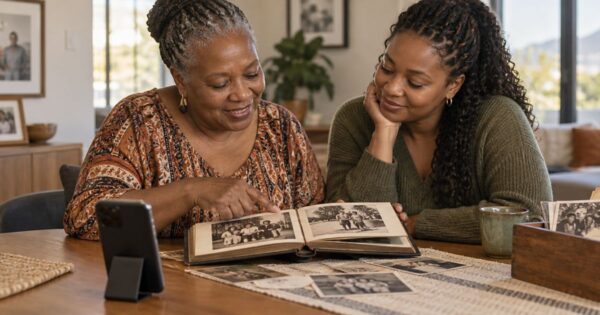
Every family has stories that live only in someone’s memory: childhood adventures, how couples met, favourite sayings, family recipes and lessons learned through experience. Unless they are recorded, many of these stories disappear over time.
When Thandi created her family heritage book, she knew it would be a substantial project. She did not realise quite how meaningful the finished books would become.
She collected six family trees covering different branches of her and her husband’s families. Wherever possible, she included birth dates and information gathered from her grandparents. She then organised family photographs into themes and stages of life.
The book included her parents’ story, including how they met, followed by memories of her grandparents. Later sections recorded her sons’ engagements, weddings, parties and other family milestones.
There were also gaps. Thandi had photographs whose stories she did not know. Some photographs had already been discarded because nobody could identify the people in them or explain why the occasion mattered.
That discovery gave the project a sense of urgency. The book would preserve details that her children and grandchildren might otherwise never know.
Thandi created the book using Orms’ photo-book software. It took several months and, because it contained many pages, the finished books cost close to R800. She kept one copy and gave one to each of her sons.
“It was an absolute labour of love,” she says, “but absolutely worthwhile.”
Begin with one story
You do not need to start with a large heritage book. The easiest approach is to record one short story each week, pair it with a labelled photograph and give a copy to someone you trust. Over time, those small contributions can become a scrapbook, digital album, printed book or family archive.
Try questions such as:
- What was my childhood home like?
- How did I meet my partner or closest friend?
- What was my first job?
- Which family tradition should continue?
- What do I want my grandchildren to remember?
- Which family recipe or saying should never be lost?
Use your phone’s voice recorder or ask someone to interview you. Give each recording a clear name, such as “Thandi – My first job – 2026”, and save a copy outside WhatsApp.
Thandi’s experience also demonstrates the importance of labelling photographs. Record the names, place, approximate date, occasion and story while someone can still provide that information. The story behind a photograph is often more valuable than the photograph alone.
Create something you can hold
Technology is only one option. A memory box can be made from a shoebox, biscuit tin or small suitcase. Add labelled photographs, letters, postcards, recipes and objects connected to your work, travels, hobbies or traditions. Include a note explaining why each item matters.
Another manageable project is a “ten photographs” scrapbook. Give each photograph its own page and write down who appears in it, where it was taken and what was happening.
If you prefer guided questions, there are several affordable options. Prices were checked on 9 September 2026 and may change:
- Exclusive Books listed its ‘Grandfather’s Memory Journal’ at R140.
- Unselfishly Me offered a South African legacy journal, including an Afrikaans edition, for R400.
- Orms offered small softcover photo books from R165.
- Q-Photo listed softcover books from R301 and hardcovers from R401.
Larger books, additional pages and extra copies will cost more, as Thandi’s project illustrates.
Get help with a bigger project
If boxes of old photographs or tapes are waiting to be rescued, professional digitisation can remove much of the technical work.
Momento lists photograph scanning at approximately R3 to R5 per photograph, depending on quantity, and VHS conversion at R180 per tape.
Video to Digital offers countrywide collection, with photograph scanning from approximately R6.50 each and VHS conversion from about R150 per tape.
For a complete life-story book, StoryKeeper South Africa costs R1,799 to R2,400 once-off. Stories can be written, dictated or recorded as audio or video. Its higher-priced option also supports telephone recording. QR codes in the finished book allow relatives to hear or watch the original recordings.
Professional services such as Life Stories and Golden Threads Collective conduct interviews and create books, audio recordings or films. Prices are supplied by quotation.
Share memories digitally
Google Photos allows families to create shared albums using the 15GB of storage included with a Google Account.
Apple users can create Shared Albums containing up to 5,000 photographs and videos without using their iCloud storage allowance.
FamilySearch Memories is a free but slightly more advanced option for connecting photographs, documents, written stories and audio to a family tree.
Do not allow an online service, WhatsApp conversation or USB drive to hold your only copy. Keep one copy on your device, another on an external drive and a third online or with a relative.
Your seven-step starting checklist
- Choose one family story or theme.
- Record or write one memory each week.
- Label photographs with names, places and approximate dates.
- Ask permission before sharing information about other people.
- Keep original photographs after scanning them.
- Give a copy of the collection to a trusted relative.
- Record who should care for the collection in future.
Frequently asked questions
What is the easiest way to preserve family memories?
Record one short story on your phone and pair it with a labelled photograph. Save a second copy outside WhatsApp and give another copy to a trusted relative.
How much does a family memory book cost in South Africa?
A home-made scrapbook can cost almost nothing. Small printed photo books start at approximately R165, while an assisted life-story service such as StoryKeeper starts at R1,799.
What are the best free tools for saving family memories?
A phone’s voice recorder, WhatsApp, Google Photos, Apple Shared Albums and FamilySearch Memories can all be used without an additional subscription. Mobile data, internet access and extra cloud storage may still cost money.
What information should I add to an old photograph?
Record the names of the people, the place, approximate date, occasion and why the photograph matters. If the exact date is unknown, an estimate such as “early 1970s” is still helpful.
Should I keep photographs after scanning them?
Yes. Digital files can be lost, corrupted or locked inside an old account. Keep important originals safely and store digital copies in more than one place.
What if my memory is beginning to fade?
Use familiar photographs, music, recipes and meaningful objects as gentle prompts. The purpose is enjoyment and connection—not testing your memory or correcting every detail. Pause if a memory causes distress.
For South African dementia information and family support, contact DementiaSA on 0860 MEMORY (0860 636 679).
Thandi’s heritage book began as a collection of family trees, photographs and remembered details. It became something much larger: a way for future generations to meet the people who came before them.
You do not need to preserve everything at once. Begin with one photograph and the story only you can tell.
A YEI Article